
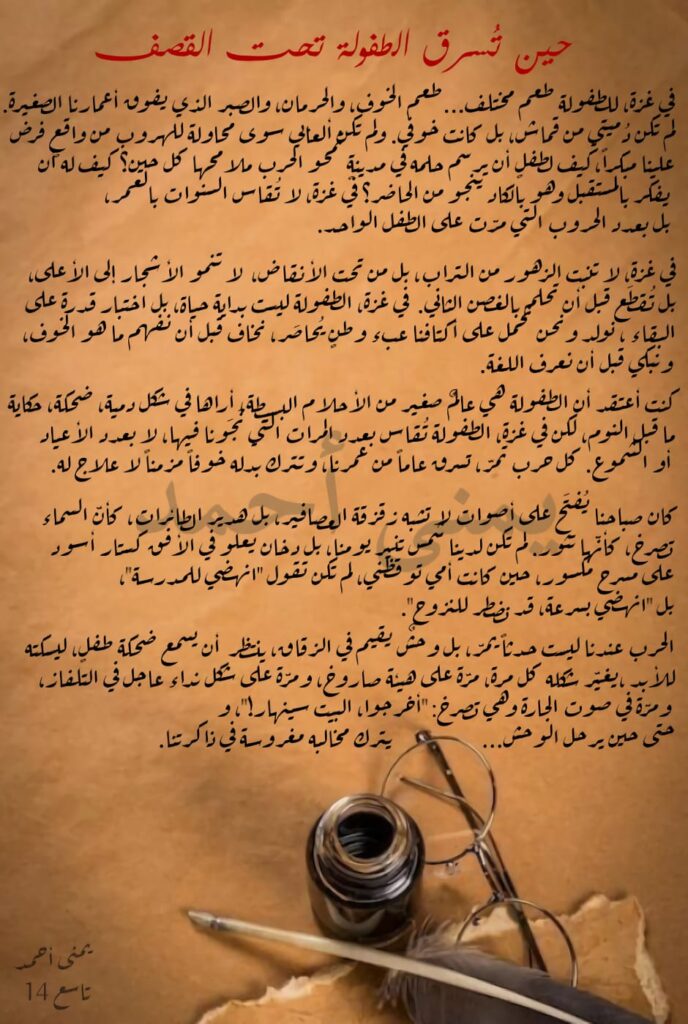
Testo di Yumna Ahmed Tasseh, 14 anni, da Gaza.
English version follows
A Gaza, l’infanzia ha un sapore diverso… Il sapore della paura, della privazione e della pazienza che va oltre i nostri anni. A Gaza, gli anni non si misurano con l’età, ma con il numero di guerre che un bambino ha attraversato. Come può un bambino sognare in una città i cui tratti sono cancellati continuamente dalla guerra? Come può pensare al futuro quando sopravvive a malapena al presente? A Gaza, gli anni non si misurano con l’età, ma con il numero di guerre che un bambino ha attraversato.
A Gaza i fiori non nascono dalla terra, ma da sotto le macerie, e gli alberi non crescono verso l’alto, ma vengono tagliati prima ancora di sognare di avere un ramo. A Gaza l’infanzia non è l’inizio della vita, ma una prova di sopravvivenza, si nasce con il peso di una patria assediata sulle spalle, si ha paura prima di capire cosa sia la paura e si piange prima di sapere cosa significhi parlare.
Che cos’è l’infanzia? Pensavo che fosse un piccolo mondo di sogni semplici, la vedevo sotto forma di una bambola, di una risata, di una storia della buonanotte, ma a Gaza l’infanzia si misura dal numero di volte che siamo sopravvissuti, non dal numero di vacanze o di estati. Ogni guerra che passa ci ruba un anno di vita, lasciandoci una paura che non ha cura.
Le nostre mattine si aprivano non con il cinguettio degli uccelli, ma con il rombo degli aerei. Il cielo urlava, come se si stesse esplodendo. Quando mia madre mi svegliava, non mi diceva: “Alzati per andare a scuola”, ma piuttosto: “Alzati in fretta, dobbiamo scappare”.
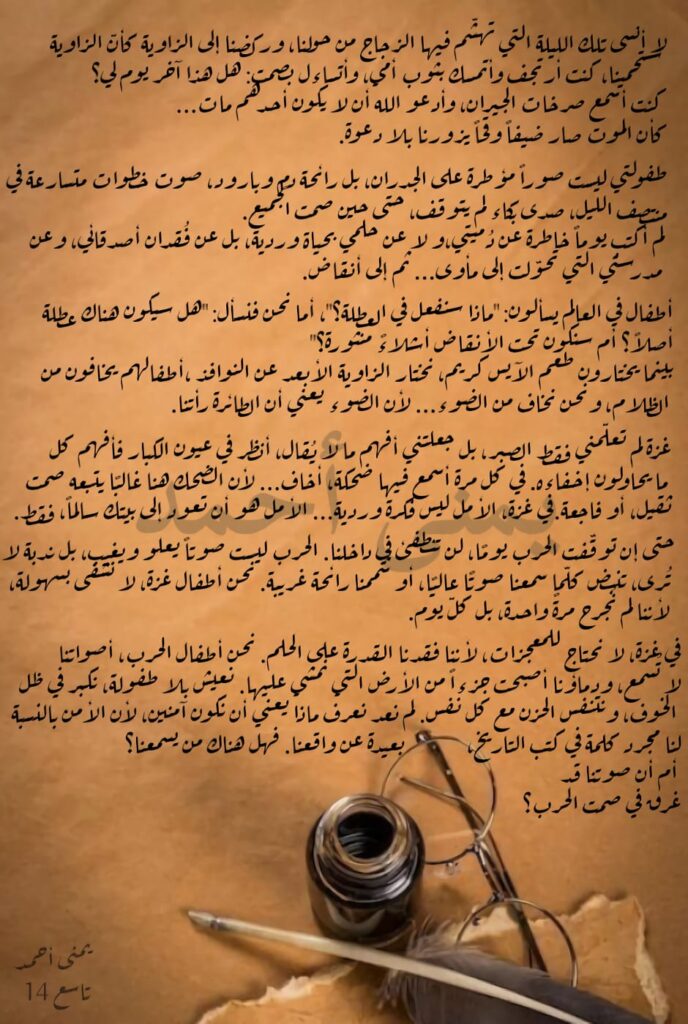
La nostra guerra non è di passaggio, ma è un mostro che vive nascosto in un vicolo, in attesa di sentire la risata di un bambino, per metterla a tacere per sempre, cambiando forma ogni volta: una volta sotto forma di missile, una volta sotto forma di chiamata urgente alla televisione, e una volta sotto forma di voce del vicino che urla “è la fine del mondo, la casa sta crollando!”. E anche quando il mostro è scomparso…
…lascia i suoi artigli conficcati nei nostri ricordi.
Non fino a quella sera, quando i vetri si frantumarono intorno a noi e noi corremmo verso un angolo della casa. L’angolo era il nostro rifugio, io tremavo e stringevo il vestito di mia madre, chiedendomi in silenzio: è questo il mio ultimo giorno?
Sentivo le urla dei vicini e pregavo Dio che nessuno di loro fosse morto. …. La morte era diventata un ospite crudele, che ci visitava senza essere invitato.
La mia infanzia non era fatta di foto incorniciate alle pareti, ma dell’odore del sangue e della polvere, del rumore dei passi accelerati nel cuore della notte, dell’eco del pianto che non cessava, anche quando tutti tacevano.
Non ho mai scritto una poesia sui miei compagni di classe, né sui sogni di una vita rosea, ma sulla perdita dei miei amici, e della mia scuola che si è trasformata prima in un rifugio… e poi in macerie.
I bambini di tutto il mondo si chiedono: “Cosa faremo durante le vacanze?”, mentre noi ci chiediamo: “ci sarà mai una vacanza, o saremo sparsi a pezzi sotto le macerie?”.
Mentre loro scelgono il gusto del gelato, noi scegliamo l’angolo più lontano dalle finestre. I loro figli hanno paura del buio e noi della luce… perché la luce significa che un aereo ci ha avvistati.
Gaza non solo mi ha insegnato la pazienza, ma mi ha fatto capire il non detto: guardare negli occhi gli adulti e capire cosa stanno cercando di nascondere. Ogni volta che li sento ridere, mi spavento… perché qui le risate sono spesso seguite da un silenzio pesante, o da una tragedia.
A Gaza la speranza non è un’idea rosea… La speranza è solo quella di tornare a casa sani e salvi.
Anche se un giorno la guerra dovesse cessare, non si spegnerà dentro di noi. La guerra non è un suono che va e viene, ma una rugiada invisibile che pulsa ogni volta che sentiamo un suono forte o un odore strano. Noi, bambini di Gaza, non guariamo facilmente perché non siamo feriti una volta sola, ma ogni giorno.
A Gaza non abbiamo bisogno di miracoli, perché abbiamo perso la capacità di sognare. Siamo figli della guerra, le nostre voci sono ascoltate e le nostre speranze sono diventate parte della terra su cui viviamo senza infanzia, crescendo all’ombra della paura e respirando tristezza a ogni respiro: non sappiamo più cosa significhi essere al sicuro, perché per noi la sicurezza è solo una parola nei libri di storia, lontana dalla nostra realtà.
C’è qualcuno che ci ascolta o la nostra voce è stata soffocata dal silenzio della guerra?
Yumna Ahmed Tasseh 14
——
English version
Text by Yumna Ahmed Tasseh, 14, from Gaza
When childhood is stolen under bombardment
In Gaza, childhood has a different taste… The taste of fear, deprivation, and patience beyond our years. In Gaza, the years are not measured by age, but by the number of wars that a child has gone through. How can a child dream in a city whose features are erased by war every time? How can he think about the future when he barely survives the present? In Gaza, the years are not measured by age, but by the number of wars that a child has gone through.
In Gaza, flowers do not grow from the dirt, but from under the rubble, and trees do not grow upwards, trees do not grow upwards but are cut down before they can even dream of a branch. In Gaza, childhood is not the beginning of life, but a test of survival, born with the burden of a besieged homeland on our shoulders, afraid before we understand what fear is, and crying before we know what language is.
What is childhood? I used to think that it is is a small world of simple dreams, I see it in the form of a doll, a laugh, a bedtime story, but in Gaza, childhood is measured by the number of times we have survived, not the number of holidays or summers.
Every war steals a year of our lives and leaves us with a fear that has no cure.
Our mornings opened to sounds not like the chirping of birds, but the roar of planes. The sky screamed, as if it were lighting up. When my mother woke me up, she didn’t say, “Get up for school”, but rather, “Get up quickly, we may have to flee”.
Our war is not a passing by, but it is like a monster that lives in the alley, waiting to hear a child’s laughter, to silence him forever, changing its shape every time: once in the form of a missile, once in the form of an urgent call on the TV, and once in the voice of the neighbour screaming: ‘it’s the end of the world, the house is collapsing!’, and even when the monster is gone…
…it leaves its claws embedded in our memories.
Not until that that night when the glass shattered around us, and we ran to a corner of our home. The corner was our shelter, I was shaking and clutching my mother’s dress, silently wondering: is this my last day?
I could hear the screams of the neighbours, and I prayed to God that none of them had died. …. Death had become an cruel guest, visiting us uninvited.
My childhood was not framed pictures on the walls, but the smell of blood and powder, the sound of accelerated footsteps in the middle of the night, the echo of crying that did not stop, even when everyone was silent.
I never wrote a poem about my classmates, nor about my dream of a rosy life, but about the loss of my friends, and of my school that turned into a shelter … and then into rubble.
Children all over the world are asking: “What will we do during the holidays?”, while we ask: “Will there ever be a holiday, or will we be scattered in pieces under the rubble?” While they choose the taste of ice cream, we choose the corner furthest from the windows. Their children are afraid of the dark, and we are afraid of the light … because the light means that the airplane saw us.
Gaza not only taught me patience, it made me understand the unsaid: to look into the eyes of adults and understand what they are trying to hide. Every time I hear laughter, I get scared … Because laughter here is often followed by a heavy silence, or a tragedy. In Gaza, hope is not a rosy idea… Hope is only that you return home safe and sound.
Even if the war stops one day, it will not be extinguished within us. War is not a sound that comes and goes, but an invisible dew that pulsates whenever we hear a loud sound or smell a strange odor. We, the children of Gaza, do not heal easily because we are not wounded once, but every day.
In Gaza, we don’t need miracles, because we have lost the ability to dream. We are the children of war, our voices are heard, and our hopes have become part of the land upon which we live without childhood, growing in the shadow of fear, and breathing sadness with every breath: We no longer know what it means to be safe, because for us, safety is just a word in history books, far removed from our reality.
Is there anyone who hears us, or has our voice been drowned out in the silence of war?
Yumna Ahmed Tasseh 14